
Disclosure: As an independent travel and culture blog, some of the links on this website are affiliate links. If you make a purchase or booking through these links, I may earn a small commission at no additional cost to you. Thank you for your support!
A Local’s Guide for Foreigners
By seven in the morning, the alleyways of Hohhot’s old town are already buzzing. Steam billows from steamer baskets outside the shaomai shops, mixing with the deep, earthy aroma of brick tea and drifting across the narrow sidewalks. Ask a local what they eat for breakfast, and nine times out of ten you’ll get one of two answers: shaomai, or lamb offal soup. That’s the real reason people line up before dawn—not some grand, tourist-friendly Mongolian feast, but squeezing into a noisy, crowded little joint, ordering a basket of steaming dumplings or a bowl of soup slicked with red chili oil, finishing it in ten minutes flat, and walking out satisfied, ready to face the day.
At the same time, the city has another breakfast tradition running alongside it, one that belongs to the Mongolian herding culture. In the Mongolian restaurants, a pot of salty milk tea, a plate of fried millet, a few pieces of dried milk curd, and maybe some hand-torn meat and fried dough sticks make for a much more unhurried, ritualized meal. But that’s a different scene, a different crowd, a different kind of place. The joints where locals go for their daily shaomai and offal soup and the Mongolian tea houses are usually blocks apart, each doing their own thing.
So here’s the first thing to figure out before you even step through a door: do you want to dive into the gritty, fast-paced street breakfast scene—the kind where you order, eat, and get out—or do you want to sit down and take your time with a proper Mongolian morning tea? Pick the right direction, and you won’t end up walking into a shaomai shop and asking if they serve milk tea.
Series One: Shaomai — Thin Wrappers, Big Flavor, Bursting with Juice
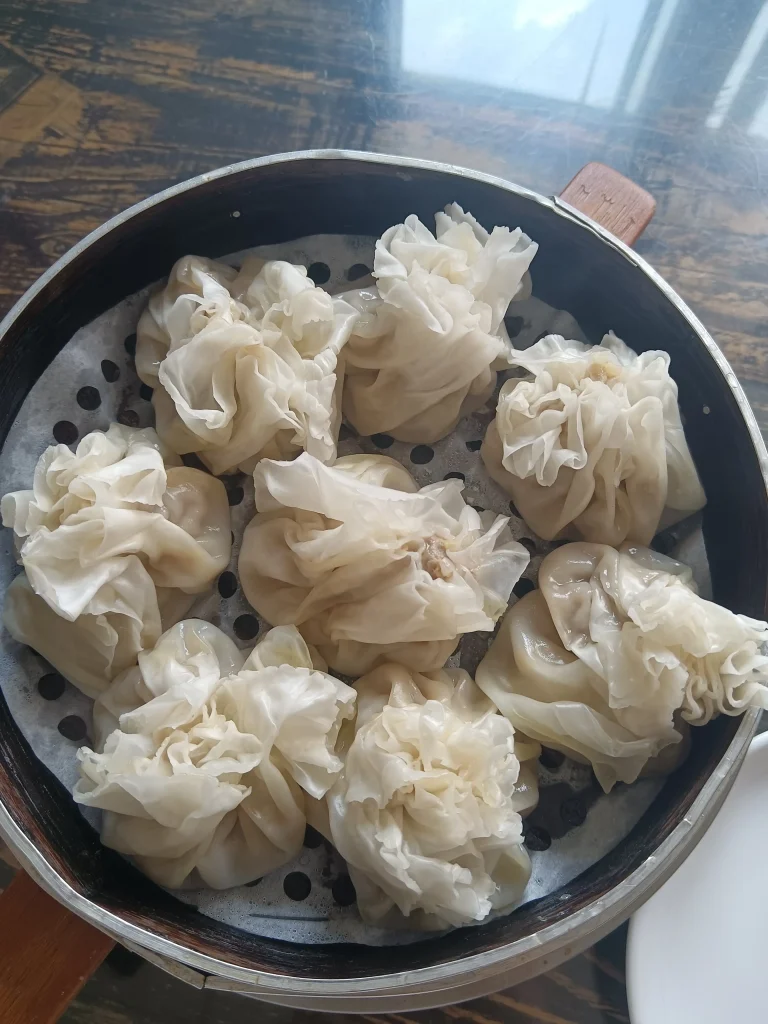
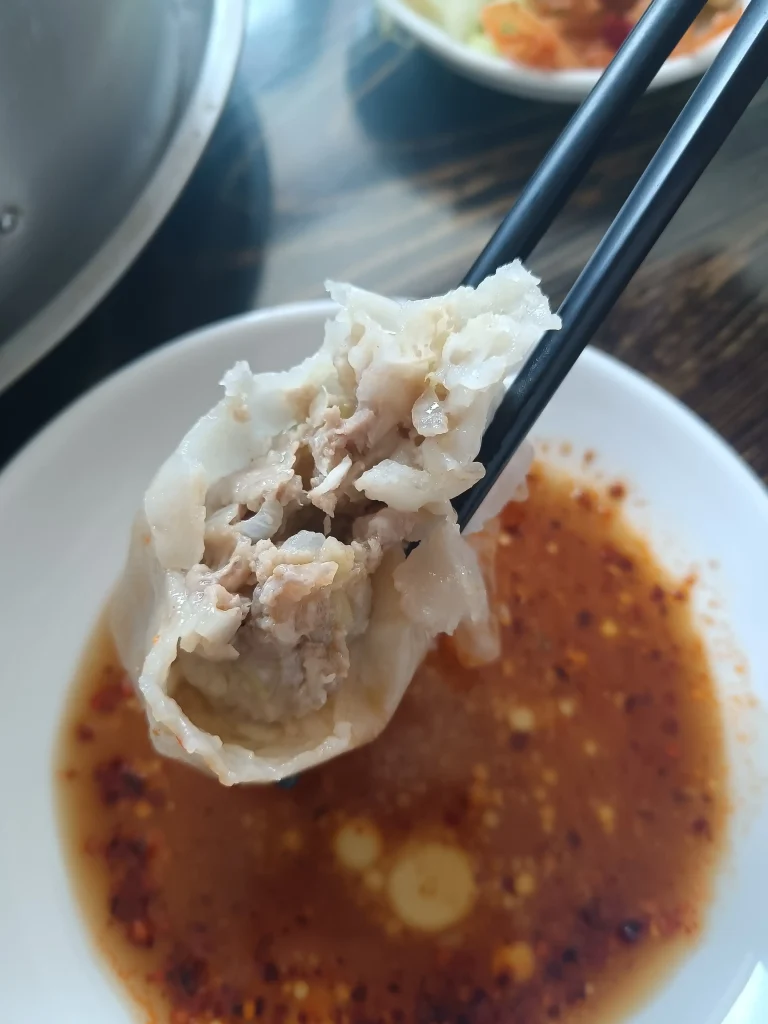
Shaomai is the undisputed king of the Hohhot breakfast table. Locals often write it as “稍麦” rather than the standard “烧麦,” because the wrapper is rolled paper-thin, gathered at the top into delicate ruffles that make each one look like a pomegranate flower about to bloom. The filling is straightforward—mutton and scallions, nothing else—and the meat is usually from the hind leg or loin of a Sunit sheep, known for being tender and completely free of that gamey taste some people can’t stand.
Here’s where tourists almost always get tripped up: on the menu, “one tael” (yi liang) refers to the weight of the dry flour used for the wrappers, not the finished product. One tael of flour makes about eight wrappers, and once those eight wrappers are stuffed with mutton and steamed, the final basket weighs nearly a pound. If the waiter asks how many taels you want and you confidently say “one jin” (half a kilogram of flour), you’ll end up with a table full of bamboo steamers you physically cannot finish. One adult can generally count on two taels being enough for a hearty breakfast; two or three people sharing four taels is a comfortable amount. Shaomai typically runs about 25 yuan per tael, so it’s an easy dish to order by feel once you know your appetite. When the shaomai arrive at your table, dip them in vinegar and chili oil, bite through the paper-thin skin, and let the hot, savory juices burst in your mouth. When you’re done, wash it all down with a cup of strong brick tea—the bitterness cuts through the mutton fat and settles your stomach. That’s how you complete a proper Hohhot shaomai breakfast.
Series Two: Lamb Offal Soup — The Street-Food Legend That Tests Your Nerve
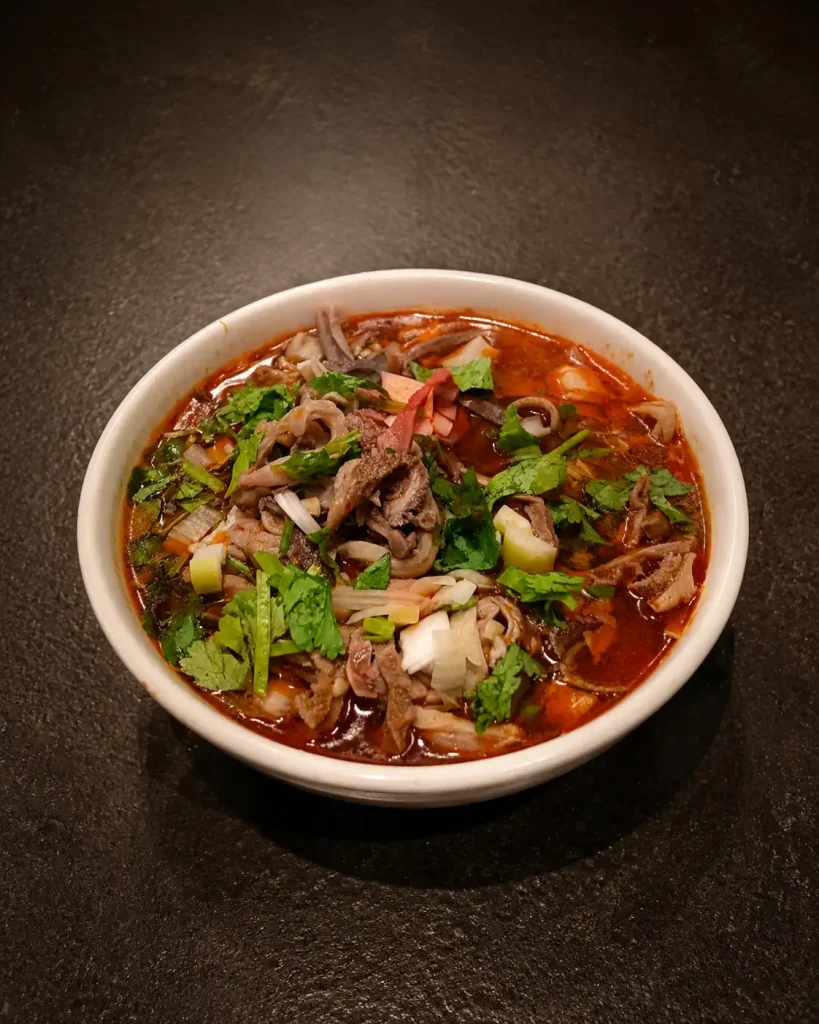
If you walk past a tiny shop packed with locals during breakfast hours, and you see steam pouring out the door and chili oil sizzling in a wok, chances are they’re selling lamb offal soup. This is the grittiest dish on Hohhot’s breakfast menu—not because it’s spicy, not because it’s salty, but because it’s made from lamb innards: tripe, intestines, heart, liver, the whole works. Simmered for hours until the broth turns milky white and velvety, it’s ladled into bowls, sprinkled with fresh cilantro, and drizzled with a spoonful of crimson chili oil before being placed, piping hot, right in front of you.
For anyone raised on neatly packaged chicken breasts and supermarket steaks, the word “offal” alone is enough to make you hesitate. That’s totally fair. But if you’re willing to take a chance on something outside your comfort zone, Hohhot’s lamb offal soup might be the one dish most worth getting over that mental hurdle for. The offal is cleaned meticulously and slow-cooked for so long that any trace of gaminess disappears, leaving nothing behind but deep, savory meat flavor and a surprisingly sweet broth. Tripe is snappy, intestines are soft and silky, heart is dense and meaty—each part brings a different texture to the bowl, and together they hit you like a fastball on a cold grassland morning. It’s rough. It’s honest.
Of course, the locals know not everyone is ready to go all in. That’s why the menu usually offers two versions: “pure tripe” and “full mix.” The pure tripe option (chun du) is exactly what it sounds like—shredded tripe and nothing else. Clean, straightforward, and almost zero psychological baggage. It’s the safest entry point. The full mix (quan za) throws in heart, liver, lungs, and everything else, for those who want the complete, unfiltered experience. Either one will run you about twenty-five yuan per bowl.
Here’s a serious local tip: don’t show up at 10 AM thinking you’re early. The real magic window is between 7:30 and 9:00 in the morning—that’s when the broth has reached its peak concentration, the tripe is at its snappiest, and the shop hasn’t started running low on the good stuff. By 10, many of these old-school places are already wrapping up the breakfast rush and switching over to lunch prep. Get there in that golden window, and you’ll taste what the hype is actually about.
And when you’re clutching that thick ceramic bowl, feeling the hot broth travel down your throat and a light sweat break out on your forehead, you’ll realize that “offal fear” is really just a reflex reaction to something unfamiliar—and once you push past it, you’ll find one of the warmest welcomes this city has to offer at dawn.
Series Three: Mongolian Morning Tea — A Grasslands Ritual

If you decide to go the Mongolian restaurant route for a traditional morning tea, the whole vibe changes. Mongolian eating customs follow a “white first, red second” order—meaning you start with dairy products (the “white foods”) and move on to meat (the “red foods”) afterward. The server will bring out a small pot of salty milk tea, along with a spread of fried millet, dried milk curds, creamy fermented milk, soft fried dough sticks, and maybe some lightly toasted yogurt flatbreads.
That salty milk tea is made by simmering brick tea leaves with fresh milk and a pinch of salt, sometimes with a little butter or dairy fat stirred in. It’s rich, smooth, and savory. If you’re used to sweet bubble tea, your first sip might throw you off. Don’t give up on it yet. Take small sips, or crumble a piece of milk curd into the bowl—the salt and the milk fat will slowly make peace on your tongue, and the flavor starts to make sense. A lot of travelers discover that this humble bowl of salty tea is exactly where their appreciation for grassland cuisine begins.
The local way to eat it is this: ladle some tea into your bowl, toss in a handful of fried millet, and break a few pieces of milk curd over the top. Wait a minute for the millet to soak up the tea and swell slightly, and for the milk curd to soften. The whole bowl becomes layered and rich—crunchy, creamy, savory, all at once. Once you’ve worked through the dairy course, if you still have room, grab a Shacong baozi—a steamed bun stuffed with wild scallions and mutton that grows on the steppe. The wrapper is thin, the filling is generous, and when you bite into it, a burst of savory juice spills out. And then there’s hand-torn mutton: big chunks of meat boiled simply in water, served with a side of wild chive flower sauce for dipping. Any serious meat lover should not miss this.
A quick word on the whole “shaomai vs. milk tea” divide: some of the oldest heritage shops still keep them strictly separate—you go to a shaomai house for shaomai, and a tea house for tea. But premium Mongolian dining establishments like Gerile Ama and Saiyide now offer both under one roof, so if you want to sample the full breakfast spectrum in a single sitting, you absolutely can.
Where to Go and How to Choose
If you want shaomai, head straight to De Shun Yuan (德顺源). It’s a century-old shop with intangible cultural heritage status—the location near Da Zhao Temple (大召寺) is especially convenient. Here’s the smart move: go have a steaming basket of shaomai first thing in the morning, and once you’re properly fed, take a leisurely stroll over to the temple. The timing works out perfectly. Another solid choice is Lao Sui Yuan (老绥元), equally well-regarded among locals.
If you’re after lamb offal soup, Bei Er Yang Za Sui Guan (贝尔羊杂碎馆) is the undisputed heavyweight in town. They clean their offal meticulously and their broth is rich and deep without being gamey.
If you’re looking for the full Mongolian tea experience, Gerile Ama Milk Tea House (格日勒阿妈奶茶馆) is the most beginner-friendly option. It’s a chain that’s dialed down the saltiness and seasoning slightly, making it highly approachable for first-timers, and their branches near the General’s Office (Jiangjun Yashu / 将军衬署) or on Xinhua Street (新华大街) are clean, comfortable, and run a fairly smooth operation. Saiyide Mongolian Dining (塞伊德蒙餐), on the other hand, originated in Xilingol (锡林郭勒) and now has branches in Hohhot on Xing’an South Road (兴安南路) and Tengfei North Road (腾飞北路). They’re known for their authentic Xilingol lamb and traditional Mongolian cooking, and they’re well worth a visit.
A few practical things to keep in mind: even though the shaomai and offal soup places have a decidedly old-school, no-frills feel, almost all of them now take mobile payments—WeChat and AliPay work just fine. Mongolian breakfast portions tend to be generous; two or three dishes are more than enough for two or three people. Don’t overestimate your appetite.
And if you want to try both milk tea and shaomai without hopping between two different neighborhoods, just pick one of the upscale Mongolian dining spots mentioned above—they’ve got you covered.
In the end, having a Mongolian-style breakfast in Hohhot is about so much more than just filling your stomach. Walk into a shaomai joint and you’ll see the rush and energy of the city at its most unpolished. Walk into a Mongolian tea house and you’ll feel the ease and depth of a grassland culture that takes its time with things. Two traditions, two rhythms. Choose the one that calls to you—or, if you’re smart about where you go, enjoy both—and you’ll taste the real flavor of a Qingcheng morning.The author spent three weeks eating breakfast across Hohhot’s old town — and gained exactly two pounds.